
Memory
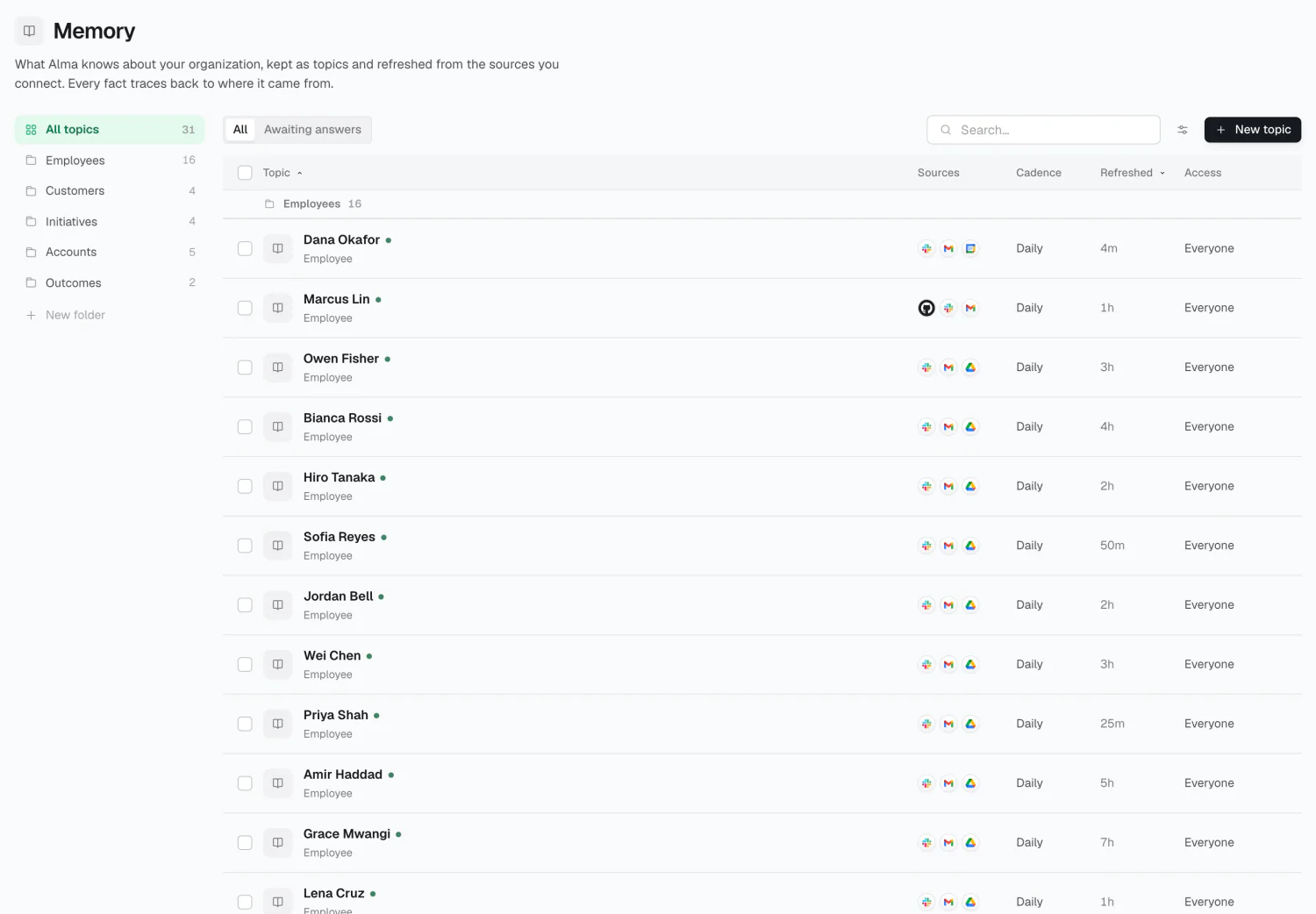
Memory is what Alma knows about your organization — a topic per account, person, or goal, kept current from your connected sources. It’s what every automation reads for context.
Topics
Section titled “Topics”A topic is a living record of one thing: an account, a person, a goal, a product. It has two parts.
Facts are structured and typed — the discount ceiling, the renewal date, the account owner. Automations read this half when they need a specific answer.
Updates are a running narrative in prose — what happened, and when. This half is for understanding a situation, not looking something up.
Every fact carries its source — the thread, document, or interview it came from.
How topics update
Section titled “How topics update”Alma reads your connected sources on a schedule and synthesizes facts.
You can also create topics by hand, or have a research campaign propose them.
Handling conflicting facts
Section titled “Handling conflicting facts”When sources disagree, Alma doesn’t guess. A topic’s New facts setting controls what happens: Auto-apply writes confident facts live; Ask first holds them as proposals for someone to accept.
Either way, a genuine conflict opens a review for the topic’s owner, with every candidate value to choose from, rather than writing a fact Alma isn’t confident about.
A topic’s type defines its fields and which sources fill them. Types are defined in Alignment → Schema.
Access
Section titled “Access”Topics carry their own access rules — a baseline plus allow/deny rules for specific groups and people. See Topics → Access.
Spaces
Section titled “Spaces”Spaces publish Memory to your team as dashboards that stay current as the underlying knowledge changes.
2026 Alma