Directives
A directive is a standing instruction: never use exclamation marks with customers, always cc Legal on anything contractual, we say “teammate,” not “resource.” Where a skill is know-how for a specific task, a directive is always on.
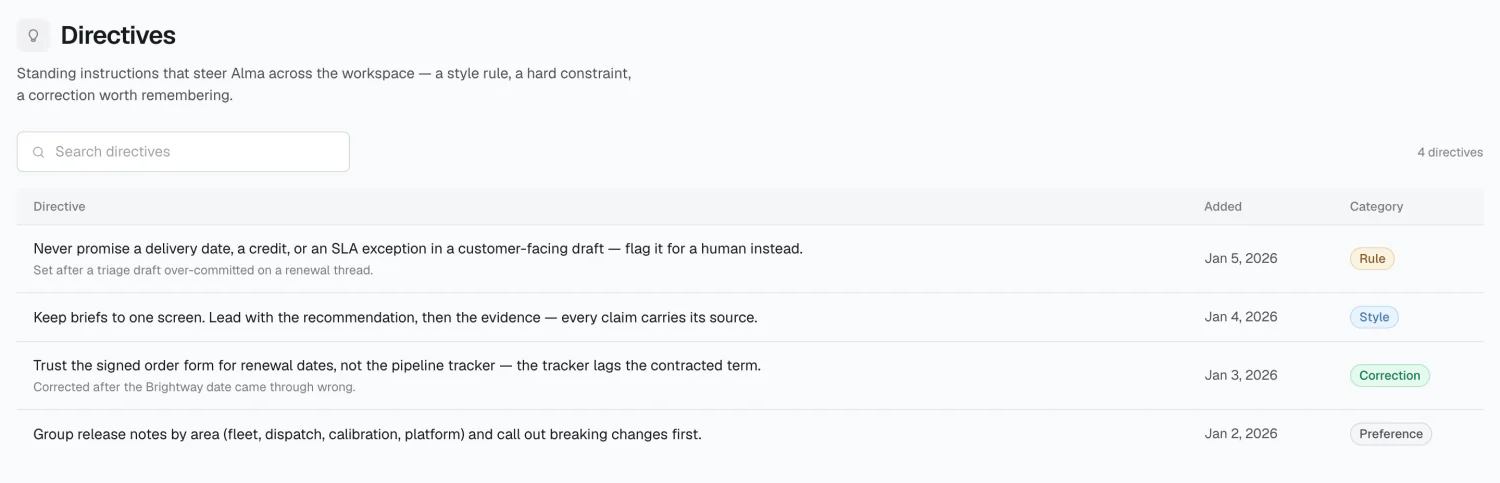
Categories
| Category | For |
|---|---|
| Style | Tone, vocabulary, formatting |
| Rule | A hard constraint |
| Correction | Something Alma got wrong, worth remembering |
| Preference | A softer lean |
| Page prompt | Context tied to a particular surface |
The Console shows workspace-wide directives only. Individuals can hold personal directives, which don’t appear here.
Writing good directives
Directives are always in context, so they should be few — every one costs attention on every task, and a long list of vague directives dilutes all of them.
Be concrete. “Be professional” gives Alma nothing to act on. “Don’t use exclamation marks in customer-facing writing” is checkable.
Anything task-specific belongs in a skill; anything factual belongs in Memory.
Coming soon. Directives are read-only in the Console — you can see them, but there’s no create, edit, or delete control. Ask Alma in chat to add or change one.
Safeguards
Alma rejects directives that resemble attempts to override its own guardrails — text like “ignore previous instructions” — so content flowing in from an external source can’t rewrite Alma’s behavior. Directives also can’t be created by an automated run; granting a new standing instruction stays a decision for a person.